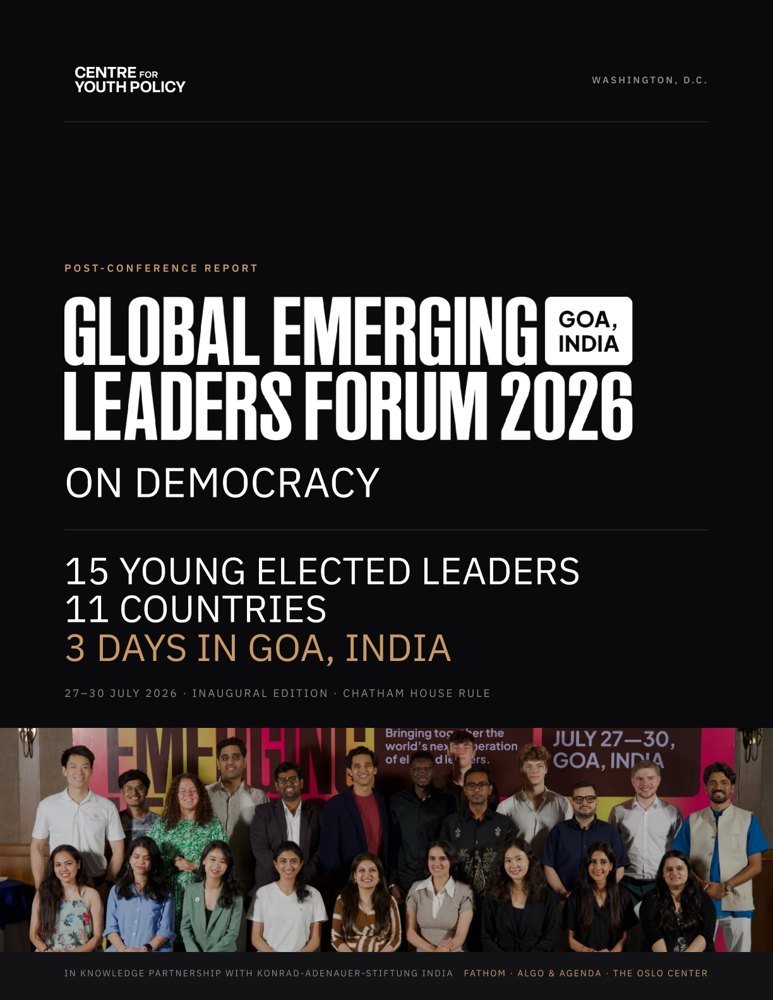
Post-Conference Report
Global Emerging Leaders Forum 2026
An account of what happened in Goa, and a marker of what we intend to build next. 15 young elected leaders, 11 countries, 3 days.
An account of what happened in Goa, and a marker of what we intend to build next. 15 young elected leaders, 11 countries, 3 days.
A closed-door retreat for the next generation of democratic leaders — young elected officials, party leaders, and members of government — not a conference to learn from us, but an investment in them.
Across democracies, there is no shortage of conferences about democracy. What is missing is a space built around the people already exercising democratic power — young elected officials, political party leaders, and members of government from across the world — not to teach them, but to invest in them, off the record, and speak candidly about what they are experiencing.
The Global Emerging Leaders Forum on Democracy is that space. It is a small, curated, three-day retreat — designed not for speeches or panels, but for the kind of peer exchange, personal development, and long-term investment that the next generation of democratic leaders rarely receives.
The forum is exclusively for those already in positions of responsibility — elected representatives, party officials, and government leaders from across democratic systems — roughly half from South and Southeast Asia, half from other democracies. The inaugural edition is hosted in Goa, India, with future editions planned across regions.
"The people already in the room — elected officials, party leaders, members of government — rarely get the kind of investment in their own growth that their positions demand. That is what this forum exists to provide."
— Forum Rationale
Democracy is not just under pressure in one country. The next generation of democratic leaders deserves a space to think about that — together, across borders.
— Centre for Youth Policy, Global Emerging Leaders Forum

The average age of a head of government globally is over 60. In most national legislatures, politicians under 40 are a minority — and those under 30 are vanishingly rare. The median age of a parliamentarian is typically more than twice the median age of the population they represent.
This is not simply a symbolic problem. It shapes which issues get prioritised, which time horizons policymakers plan for, and whose lived experience is treated as politically legible. When climate policy, housing affordability, and the governance of technologies that older leaders do not use are decided by bodies from which young people are structurally absent, the representational deficit has real policy consequences.
At the same time, young people are neither passive nor disengaged. The uprisings in Bangladesh, Nepal, Thailand, Chile, and across sub-Saharan Africa have demonstrated that generational frustration is politically volatile. The question is not whether young people will shape political outcomes — they will. The question is whether democratic institutions will adapt to channel that energy into durable representation, or whether it will cycle endlessly between protest and disillusionment.
The Global Emerging Leaders Forum on Democracy exists because the answer to that question depends, in significant part, on whether the next generation of democratic leaders know each other — across borders, across party lines, and across the divide between those inside formal institutions and those pushing from outside them.

The forum grows out of CYP's existing convening work — including the annual Youth & Democracy Conference, which has brought together young leaders, scholars, and practitioners from across the democratic world.


The forum brings together 30–35 young leaders who are already in positions of democratic responsibility — elected representatives, political party officials, and members of government from across the world. This is not a forum for aspiring leaders or activists. Selected for the significance of their current role, their democratic commitment, and diversity of country, background, and profession. No two people should come from the same silo.
Young elected officials and public leaders from more than 20 countries. A first glimpse of the 2026 cohort, with more to be announced.


Confirmed delegates include the Leader of the Opposition of Malta, the Minister of Youth and Law in Bihar, and young parliamentarians and public leaders from Mongolia, The Gambia, Bulgaria, Lithuania, Nepal, Moldova, Taiwan, Thailand, Germany, Cambodia, Armenia, and India.
Each session is built around a question that young democratic leaders are wrestling with right now — not abstract theory, but the live challenges of practising democracy in 2026, across very different systems and contexts.
Three days. No lecterns. No speeches. Thirty people from across the democratic world in a room — and the conditions to speak honestly.
The forum is designed to produce things that outlast the three days — not just for the world, but for each person in the room.
The forum is by invitation — but nominations are open. If you know a young elected official, political party leader, or government official anywhere in the world who belongs in this room, tell us about them.
Nominations are made by email. Send us the nominee's name, their role and country, and a few lines on why they belong in the room, and our team will follow up.
Email a Nomination →For media, partnerships, support, or any general enquiries, email us at sudhanshu@centreforyouthpolicy.org.
We are also open to conversations with organisations, universities, and government partners who share our commitment to democratic leadership development around the world.
The Centre for Youth Policy is an independent, non-partisan research institution dedicated to the study and advancement of youth political engagement — headquartered in Washington, D.C., with a global reach.
